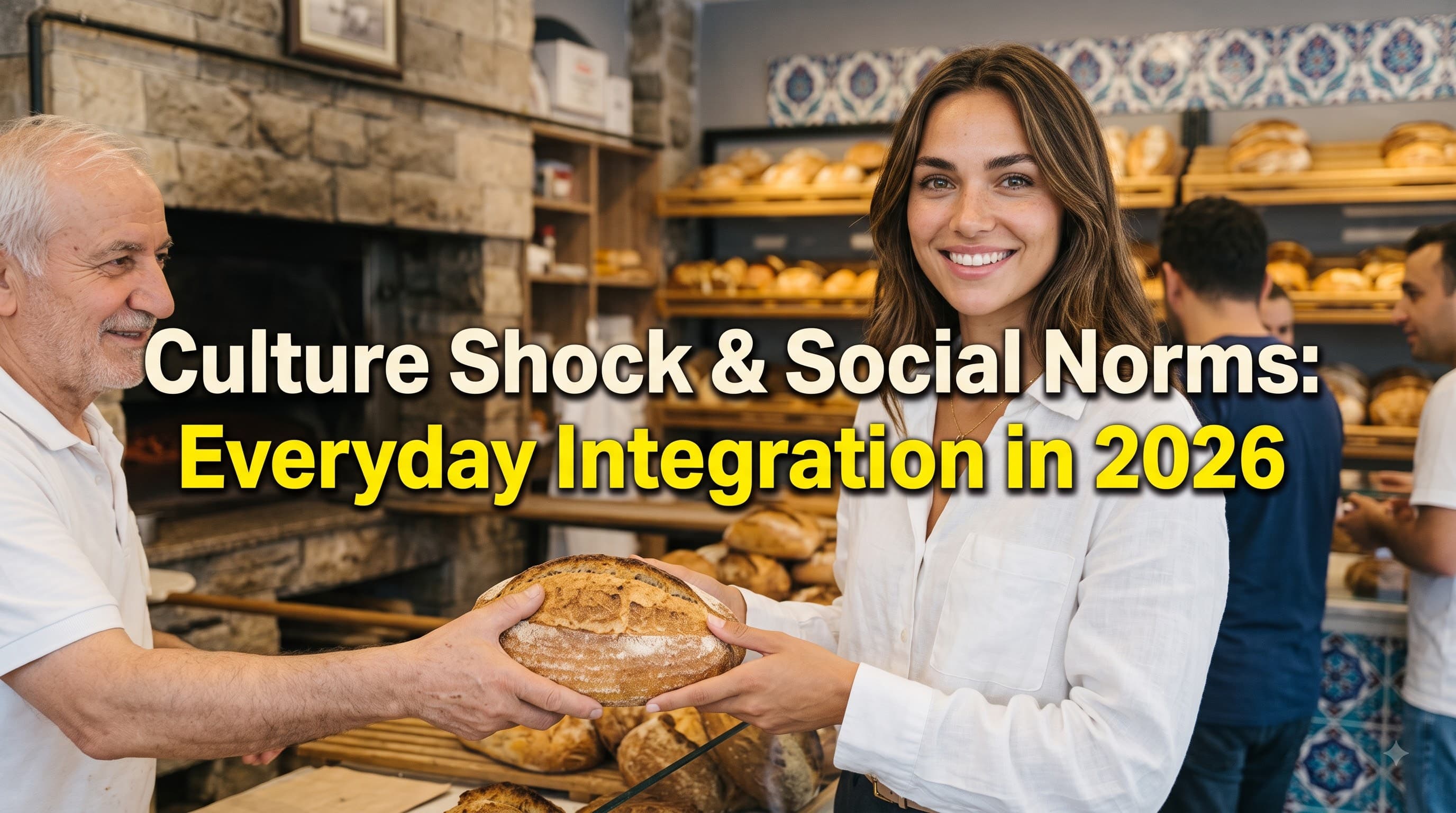
Moving to Istanbul is easy to romanticize and, in the first few months, genuinely easy to enjoy. What catches most expats off guard isn't the bureaucracy — it's the everyday social terrain: hospitality customs, personal space, and community norms that work very differently than back home.
The Four Stages of Integration
- Honeymoon: everything feels novel and charming — the call to prayer, the tea culture, the Bosphorus views.
- Friction / culture shock: small daily frictions accumulate — bureaucratic pace, communication style, noise levels — and start to wear on you.
- Adjustment: you build routines, learn the unwritten rules, and friction eases.
- Bicultural mastery: you move comfortably between Turkish and your home culture's norms, code-switching without much effort.
Where Western and Turkish Norms Differ Most
- Communication style: Turkish conversation is often more indirect and relationship-first than blunt Western directness — a straight "no" is rare; read the softer cues.
- Hospitality (İkram): refusing offered tea, coffee, or food can read as a real rejection, not a polite pass — accept at least a token amount even if you're full.
- Personal space: standing and conversational distance is closer than in the US, UK, or Northern Europe — this isn't rudeness, it's the norm.
- Community (Komşuluk): neighbors look out for each other more actively than in most Western cities — expect more casual dropping-by and involvement than you might be used to.
- Commerce and bargaining: haggling is expected in bazaars and with independent shopkeepers, but not in supermarkets or chain stores — know which mode you're in.
Everyday Etiquette Checklist
- Remove shoes when entering a Turkish home
- Say "Kolay Gelsin" ("may it come easy") to someone working, as a friendly acknowledgment
- Show visible respect to elders — offering a seat, greeting them first
- Accept offered tea graciously, even briefly, rather than declining outright
- Return a neighbor's gift plate with something on it, rather than empty
- Dress modestly (covered shoulders and knees) when visiting a mosque
A Practical Integration Roadmap
Step 1: Learn five magic phrases. "Kolay gelsin" (may it come easy), "Afiyet olsun" (enjoy your meal), "Elinize sağlık" (health to your hands, said to a cook), "Geçmiş olsun" (get well soon), and "Hoş geldiniz" / "Hoş bulduk" (welcome / the reply to it) go a long way in daily interactions.
Step 2: Build relationships with local shopkeepers (Esnaf). Your corner grocer, tailor, and coffee vendor become informal community anchors — repeat visits and small talk build real goodwill and, often, better prices.
Step 3: Learn your neighborhood's weekly market (Semt Pazarı). Every district has a weekly open-air market with the freshest and cheapest produce — find yours and go regularly.
Step 4: Understand apartment-building culture (Apartman Kültürü). Buildings have a monthly maintenance fee (Aidat) and often an informal building manager (Kapıcı) — introduce yourself early and learn the building's unwritten rules around noise, trash, and shared spaces.
Step 5: Join expat and community networks. Local expat groups (in-person and online) shortcut a lot of the trial-and-error of settling in, from recommending doctors to flagging scams.
Common Friction Points
- Over-hospitality: being offered food repeatedly can feel overwhelming to newcomers — a polite, firm "Çok teşekkürler, doluyum" ("thank you so much, I'm full") is accepted and not rude.
- Bureaucratic communication gaps: government offices often assume local-level Turkish fluency and process knowledge — bring a Turkish-speaking friend or use a translation app rather than expecting English support.
- Stray-animal care norms: Istanbul's famous street cats and dogs ("Catstanbul") are a genuine part of civic culture, cared for collectively by neighborhoods — feeding stations and shelters are common and welcomed, not a nuisance.
Frequently Asked Questions
Is Istanbul safe for a foreigner living alone? Yes, broadly — like any major city, use normal precautions, and note that pickpocketing in tourist-heavy areas is a bigger practical risk than violent crime.
Do I really need to learn Turkish to live comfortably in Istanbul? English gets you far in central, expat-heavy neighborhoods, but basic Turkish dramatically improves daily life — dealing with bureaucracy, tradespeople, and older neighbors especially.
Is tipping expected? Yes — roughly 10% at restaurants (check if service is already included), and small tips are appreciated for taxi drivers, hairdressers, and hotel staff.
What should I wear day to day? Istanbul is largely modern and cosmopolitan — dress as you would in any major European city, with more modest dress expected specifically inside mosques.
What's the emergency number? 112 for all emergencies (police, ambulance, fire) — the equivalent of 911.